
AI-Generated IETF Reports
Friday, 08 November 2024 · 1 minNote: AI-generated reports from this research are available in the accompanying paper as a proof of concept, including downloadable PDFs and source LaTeX files.
As a side project, I’ve been exploring how AI can automate IETF report generation. I presented this work at RASPRG during IETF 121, with the full technical details available in the accompanying paper.
IETF working group reports are essential but time-consuming to produce. With hundreds of working groups meeting several times per year, the question is whether GenAI can reliably summarize technical discussions and extract meaningful insights.
IETF documents work particularly well with LLMs because they use structured plaintext and markdown, have consistent sections like security considerations, and include standardized protocol interactions. RFCs also are already part of most LLM training datasets, providing significant advantages over processing arbitrary documents.
The workflow combines four stages: data retrieval using rsync and crawling, preprocessing to normalize names and structure data, RAG integration with customized prompts, and report generation in LaTeX or Markdown with post-processing corrections.
I tested both local and API-based models:
| Model | Parameters | Type | Context Window |
|---|---|---|---|
| GPT-4 | 1.76T | API | 8,192 tokens |
| Claude 3 Sonnet | 175B | API | 100,000 tokens |
| Command-R | 35B | Local | 131,072 tokens |
| Mixtral | 46.7B | Local | 32,768 tokens |
| Llama 3 | 8B | Local | 8,192 tokens |
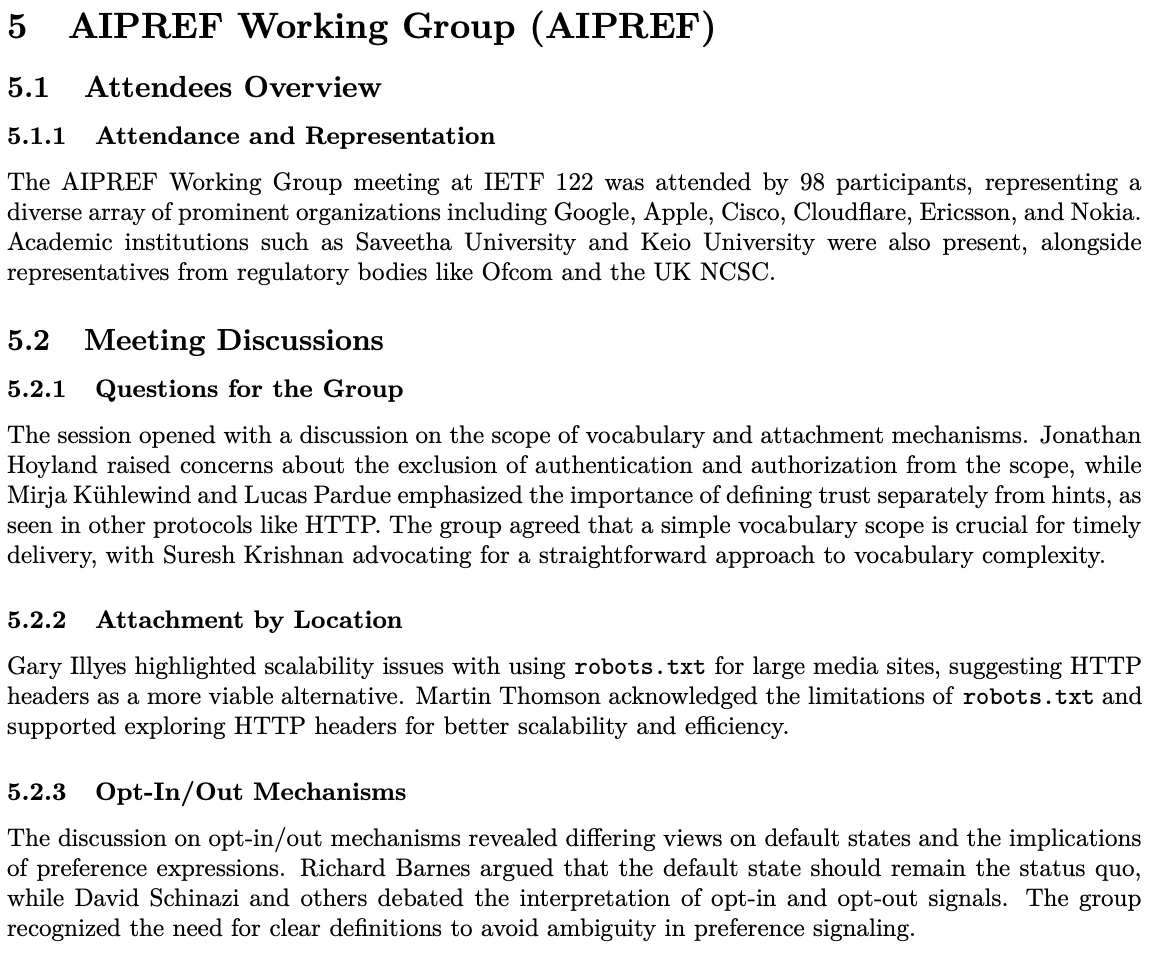
The system produces generally accurate reports with correct event descriptions, participant affiliations, and discussion summaries. For example, the generated report correctly identifies that the AIPREF Working Group had 98 participants from organizations like Google, Apple, and Cisco, and accurately summarizes key discussion points, the presenters and the topics (vocabulary scope and attachment mechanisms for example).
Timewise, I spent most effort on the preprocessing and data normalization than on anything else. For future work I could try adding better reasoning strategies (e.g., ReAct, CoT), perform some cross-working group analysis, and potentially integrating this approach into the official IETF toolchain.