Voice Agents are useful again
Sunday, 04 October 2026 · 9 minsI’m a big fan of the Bobiverse, Dennis E. Taylor’s series that starts with We Are Legion (We Are Bob). Bob Johansson is a software engineer who signs up for cryonic preservation, gets hit by a car the next day, and wakes up a hundred-odd years later as a replicant, a scanned copy of his mind running an interstellar Von Neumann probe. The ship comes with GUPPI, the General Unit Primary Peripheral Interface, which handles the mundane parts of running a probe so Bob can think. Bob gives it Admiral Ackbar’s face and voice, because he can. GUPPI does the boring work, reports back in a sentence, and says so when something won’t work.
That’s the assistant I wanted, so I built one I can talk to from my phone and called it GUPPI.
The call
GUPPI is a single FastAPI app (app.py) on the host. I call a session a call, but there’s no phone network involved: an app on my phone streams audio to the daemon over WebRTC, with a plain WebSocket as fallback.
Once a call connects there’s a persistent Brain wrapping a ClaudeSDKClient session. Audio comes in, gets transcribed, becomes a turn, and the brain turns SDK events into speech, with tool calls shown on screen but never read aloud. Closing the app doesn’t end the session; the next call picks up where the last one stopped. Part of GUPPI’s job is to filter the massive output these systems produce down to what I need to hear: a sentence or two out loud, the rest on screen.
What’s inside
Pipecat runs the audio as a pipeline of stages: Silero VAD and smart-turn decide when I’ve stopped talking, Whisper on MLX turns the audio into text (Parakeet and whisper.cpp are the fallbacks), and Kokoro turns the reply back into speech. Kokoro’s voice quality is fantastic for a local model; I expected to need a cloud voice and never did. All of it runs on the host from local model files; nothing in the audio path touches the network.
What I talk to is a claude-agent-sdk session streamed to the phone app. It has what my desktop Claude Code has: the same skills and workflows, my MCP servers and knowledge bases, and the ability to launch subagents. The daemon adds a few MCP servers of its own for the call: vault (my Obsidian notes, todos and daily notes), history (past calls and transcripts) and pane/panes (the Claude Code and Kiro panes running on the host). Every tool call passes through a safety gate: secret files are off limits, and privileged actions stop and ask me before they run.
Handing off
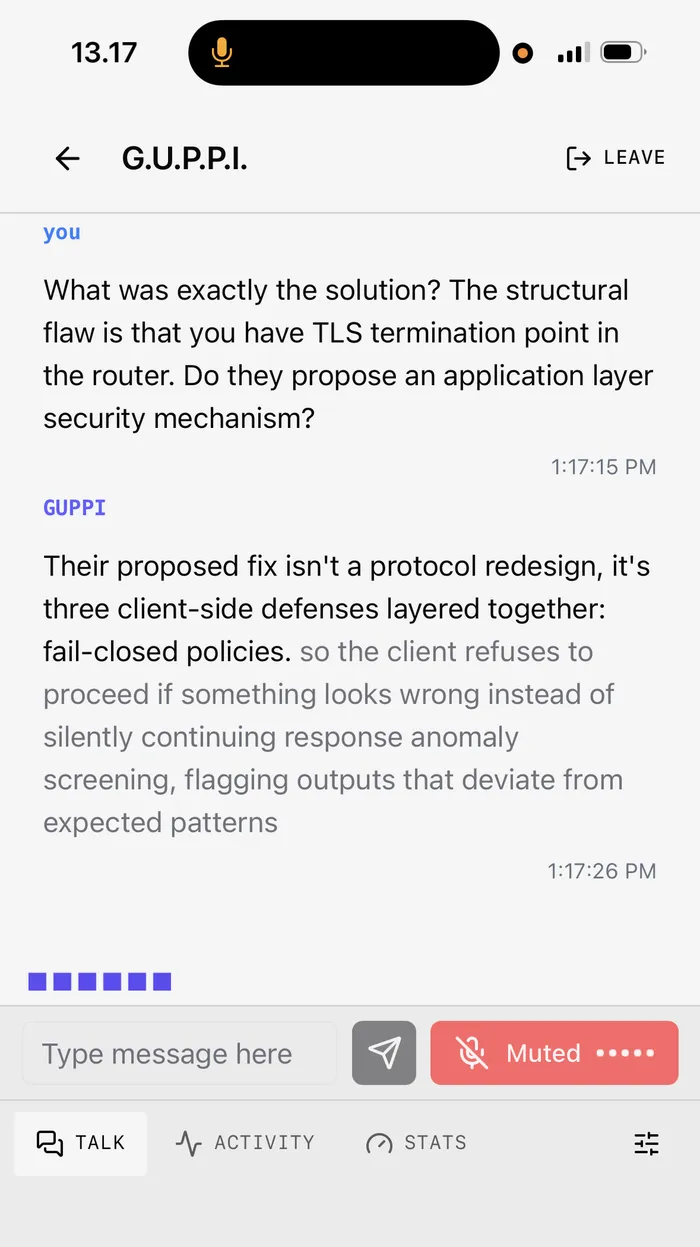
The real design decision is when GUPPI uses the tools itself and when it hands off. Quick things, a lookup or a small edit, happen in the turn. Anything longer, a note that needs real drafting or a research question, launches as a background subagent (the Agent tool with run_in_background), so the call stays open and I keep talking while it works. Project work goes to whichever coding-agent pane owns that project, with GUPPI as interpreter: it tightens what I said, sends it, and reads back the pane’s dialogs. Notes and research never go to a pane, and when GUPPI is unsure, neither does anything else.
When things fail
Sometimes processes fail. A blocked write, a cancelled pane message, a dialog asking to confirm something destructive: all of them get the same treatment. Say in one sentence what failed, offer the next step, and never pretend there’s an approval prompt to go check, because on a voice call there isn’t one. The list of destructive commands is shared between the pane keystroke tool and the file tools, so a “yes” on a call can never approve a force push or a deletion.
Here’s the shape of it:
Why now
A few years ago a voice assistant on your phone meant Siri: a flat command grammar, no memory across calls, and nothing to fall back to when it misheard you. The voice part is pretty much the same today. What changed is that there’s now somewhere real to send the work: my own data over MCP, subagents for the slow stuff, panes for project work, and an assistant that says so when one of them fails. Low friction was always the promise of voice; it just needed a back end. If you want more detail on any of the pieces, ask.
What it sounds like
GUPPI has since moved from Kokoro to Drama 3, which clones a voice from a short reference clip. Three samples, all rendered on the host. The first is GUPPI’s everyday voice, Ben, reporting back:
Drama 3 also takes delivery directions written into the text, in brackets. GUPPI chooses them per sentence, so bad news sounds different from good news. Here is Ben saying the same line three ways, [cheerful, upbeat, smiling], [tired, flat, end of a long day] and [urgent, fast, alarmed]:
“The build is green, and the deploy is waiting for your yes.”
The third is Romero, the voice I switch to for fun, sending me to bed when I try to start one more thing late at night:
“Then rest, my friend. The x402 will wait. Even the greatest hero needs the night.”
Note: GUPPI wrote this post itself, from a background task I handed it. I made minor corrections and suggestions along the way.